Dutch Tax Filing for Entrepreneurs: The Complete 2026 Founder’s Guide
Imagine it's late April and you're staring at the Mijn Belastingdienst portal, squinting at Dutch legal terms that feel like a secret code. You aren't alone. Many expats and founders feel that same pit in their stomach as the May 1 deadline approaches. Managing your dutch tax filing for entrepreneurs shouldn't feel like a solo battle against a faceless machine. It's actually a chance to check the pulse of your business and ensure you're keeping more of what you earn.
We agree that the Belastingdienst, or Dutch Tax Office, can feel intimidating when you're balancing a BV (private limited company) or working as a ZZP (self-employed professional). This guide promises to strip away the jargon and show you exactly how to stay compliant while maximizing your credits. You'll learn about the 2026 tax brackets, the updated €1,200 zelfstandigenaftrek (self-employed deduction), and the strategic steps to keep your focus on growth instead of paperwork.
Key Takeaways
-
Learn the essential deadlines and pillars of dutch tax filing for entrepreneurs to keep your business fully compliant without the stress.
-
Compare the tax impact of an eenmanszaak (sole trader) against a BV (limited company) to ensure your business structure still matches your growth.
-
Uncover hidden deductions and allowances, such as the KIA for tech investments, to maximize your year-end savings.
-
Build a simple compliance routine using digital tools that transform your annual bookkeeping from a chore into a strategic asset.
-
Transition from managing paperwork to scaling your vision by finding a partner who prioritizes your human needs over clinical compliance.
Table of Contents
The Dutch Entrepreneurial Tax Landscape in 2026
The Dutch tax system operates on a foundation of transparency and trust, but it requires you to be proactive. For the 2026 tax year, the government continues to phase out certain benefits for the self-employed, making it more important than ever to understand where you stand. Managing your dutch tax filing for entrepreneurs isn't just about handing over numbers; it's about understanding the three pillars that support your business: BTW, Income Tax, and Corporate Tax.
BTW (Omzetbelasting) is the Value Added Tax you add to your invoices, usually 21% or 9%. You're essentially a temporary collector for the state. Income Tax (Inkomstenbelasting) applies to your personal earnings if you run an eenmanszaak (sole proprietorship). If you've scaled to a BV (private limited company), you'll deal with Corporate Income Tax (Vennootschapsbelasting) on company profits instead. Each pillar has its own rhythm, and missing a beat can lead to unnecessary stress and penalties.
The Entrepreneur Check: Tax vs. Trade
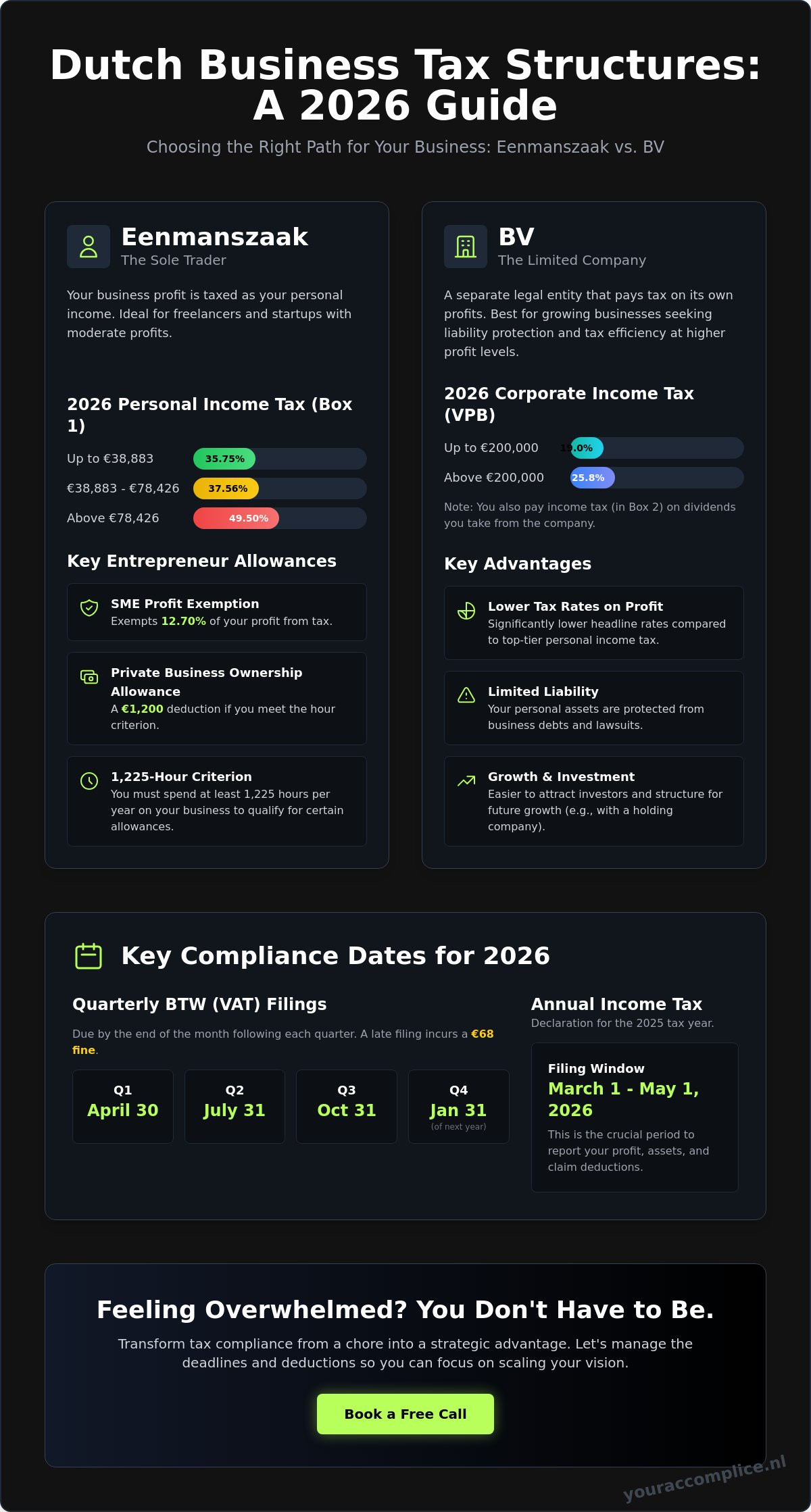
Many founders assume that a registration with the Chamber of Commerce (KVK) automatically makes them an entrepreneur for tax purposes. It doesn't. The Belastingdienst uses a specific "entrepreneur check" to decide if you qualify for lucrative deductions. To pass, you generally need to show you carry entrepreneurial risk, aim for profit, and have multiple clients. Most importantly, you must meet the 1,225-hour criterion. This means spending at least 1,225 hours per year on your business to unlock the €1,200 zelfstandigenaftrek (self-employed deduction) in 2026.
2026 Tax Deadlines and Compliance Calendar
Your calendar is your best friend when it comes to compliance. For most, the year is defined by quarterly BTW filings. These are due by the end of the month following each quarter: January 31, April 30, July 31, and October 31. If you're even a day late, the Belastingdienst issues a standard fine of €68, which is an avoidable waste of your hard-earned cash.
The big event is the annual income tax declaration. The filing window for the 2025 tax year opens on March 1, 2026, and closes on May 1, 2026. This is where you'll navigate the Dutch income tax system to report your profit, personal assets, and any deductions. You might also receive a Voorlopige Aanslag (Provisional Assessment). This is an estimate of the tax you'll owe for the current year, allowing you to pay in installments rather than facing one massive bill at the end. It helps keep your cash flow predictable and manageable.
Does this feel like a lot to track while you're trying to build a brand? We'd love to help you simplify the process. Why not book a free introductory call with us to see how we can take these deadlines off your plate?
Choosing Your Structure: Eenmanszaak vs. BV Taxation
The Dutch tax office likes boxes. Specifically, three of them. Box 1 covers your income from work and your primary residence. Box 2 is for income from a substantial interest, like dividends from your own company. Box 3 is for your wealth, including savings and investments. For most, dutch tax filing for entrepreneurs happens primarily in Box 1, but as you grow, Box 2 becomes your strategic playground. Understanding which structure fits your current profit level is the difference between overpaying and building a lean, tax-efficient machine.
Taxation for the Eenmanszaak
If you're a freelancer or ZZP (Zelfstandige Zonder Personeel), you likely operate as an eenmanszaak (sole trader). In this setup, you and your business are one and the same in the eyes of the Belastingdienst. Your profit is taxed as personal income in Box 1 using progressive rates. For the 2026 tax year, the first €38,883 of your profit is taxed at 35.75%. The middle bracket, up to €78,426, sits at 37.56%, while anything above that is taxed at 49.50%.
To soften this, you can claim the MKB-winstvrijstelling (SME profit exemption), which exempts 12.70% of your profit from tax in 2026. If you meet the Dutch government criteria for entrepreneurs, including the 1,225-hour rule, you also qualify for the zelfstandigenaftrek (self-employed deduction). This deduction is €1,200 for 2026.
Taxation for the Founder (BV and Holding)
As your profit climbs, a BV (Besloten Vennootschap) often becomes more attractive. A BV is a separate legal person. It pays Corporate Income Tax (VPB) on its profits. In 2026, the rate is 19% on the first €200,000 of profit and 25.8% on everything above that. This is significantly lower than the top personal income tax rates.
However, the BV comes with more rules. You'll likely be a DGA (Director-Major Shareholder), meaning you must pay yourself a "usual wage" (gebruikelijk loon) that reflects market standards. This salary is taxed in Box 1. Any remaining profit can be distributed as dividends, taxed in Box 2 at 24.5% for the first €68,843 and 31% thereafter. Using a Holding structure allows you to reinvest these profits into new projects or assets without immediate dividend tax hits.
The financial tipping point where a BV becomes cheaper than an eenmanszaak usually lands around €100,000 in annual profit. If you're approaching that milestone, it might be time to chat about your structure to ensure you aren't leaving money on the table.
Maximizing Deductions: The Entrepreneur's Advantage
Think of every euro you spend on your business as a potential reinvestment. Many founders view dutch tax filing for entrepreneurs as a defensive move to avoid penalties. We prefer to see it as an offensive growth strategy. By identifying every legitimate deduction, you lower your taxable profit, which leaves more cash in your bank account to hire your next team member or upgrade your tech stack. It's your money. You should keep it.
The Small Investment Allowance (Kleinschaligheidsinvesteringsaftrek or KIA) is a perfect example of this. If you invest in assets like high-end laptops or office equipment, you can often deduct a percentage of that investment directly from your profit. Beyond hardware, your daily operational costs are also on the table. This includes everything from your Slack subscription to the specialized software you use for project management. The Dutch Tax and Customs Administration allows for these deductions as long as they are "wholly and exclusively" for business use. Even a portion of your phone bill or internet costs can be claimed if you use them to keep your business running.
Smart Business Deductions for 2026
The home office remains a hot topic for the modern workforce. However, the Belastingdienst is strict. To deduct your home office, it generally needs to be a self-contained unit with its own entrance and sanitary facilities. If you don't meet these "dedicated workspace" rules, don't worry. You can still deduct 100% of your business travel costs via public transport or claim €0.23 per kilometer for business trips made in your private car. Professional development is another win; costs for seminars, books, and courses that maintain your professional knowledge are fully deductible investments in your own growth.
Every business is different, and what works for a tattoo artist might not apply to a cybersecurity consultant. If you're wondering which of these deductions apply to your specific situation, let's talk. You can book a free introductory call with us to map out your 2026 strategy.
How to File: A Step-by-Step Compliance Routine
Filing your taxes shouldn't feel like a high-stakes exam. It's simply the final step of a year's worth of business decisions. If you've been keeping up with your bookkeeping throughout the year, the actual dutch tax filing for entrepreneurs is mostly a matter of verification. The goal is to move from a pile of receipts to a clean Profit and Loss (P&L) statement and a Balance Sheet that reflects your hard work.
The filing window for the 2025 tax year opens on March 1, 2026. While many wait until the last minute, getting your data ready in March gives you a clear view of your cash flow for the year ahead. It also ensures you have enough time to resolve any discrepancies before the May 1 deadline. Accuracy is your best defense against the stress of an unexpected audit.
Preparing Your Financial Statements
Your P&L is a summary of your revenue and expenses. It shows what you actually earned after costs. Your Balance Sheet is a snapshot of what your business owns, like your tech gear or bank balance, and what it owes on December 31. These documents are the backbone of your IB aangifte (income tax return).
We often see founders struggle when their personal and business finances are tangled. Using dedicated bookkeeping software isn't just a "nice to have" anymore; it's essential for avoiding errors that catch the eye of the Belastingdienst. Inconsistent BTW (VAT) totals or sudden, unexplained drops in profit can trigger unwanted questions. Our Eenmanszaak Package and Founder Package are designed to keep your data clean year-round, so you aren't scrambling in April with a shoebox of receipts.
The Submission Process
The biggest hurdle for many expats is the Mijn Belastingdienst portal. It's entirely in Dutch. Even with browser translation, the legal nuances can get lost. To log in, you'll need your DigiD if you're an eenmanszaak (sole trader). If you run a BV (limited company), you'll likely use eHerkenning, which is a secure digital identity specifically for businesses.
Once you're in, you'll follow a series of screens to report your profit, assets, and any personal deductions. If the May 1, 2026 deadline feels too close, you can request an extension. This usually gives you until September 1, 2026, to file your income tax declaration. When you finally receive that blue envelope with your assessment, look for the Vastgestelde Aanslag (Final Assessment). If the numbers match your records, you're all set. If they don't, you have six weeks to lodge an objection.
If the Dutch portal still feels like a maze, let's walk through it together during a short call. We can help you understand exactly what the tax office is asking for without the stress of a translation app.
Beyond Filing: Why You Need an Accomplice
Choosing an accountant is usually a choice between various shades of grey. Most traditional firms focus entirely on the past. They tell you what happened last year and send you a bill for the privilege. We take a different approach. As your accomplice, we look forward. We believe dutch tax filing for entrepreneurs should be a collaborative routine that fuels your business rather than draining your energy. We act as a buffer between you and the technical complexities of the Belastingdienst.
Our goal is to move you from a state of reactive stress to one of proactive growth. By the time the filing window opens on March 1, 2026, you shouldn't be worried about what you might have missed. You should be looking at your clean financial statements and planning your next big move. We handle the paperwork so you can handle the vision.
The Human First Philosophy
Our human-first philosophy means we talk like people, not compliance manuals. We understand that whether you're a tattoo artist or a cybersecurity expert, your time is your most valuable asset. You shouldn't spend it deciphering Dutch legal letters. We value clarity over complexity in every conversation — explaining things like the 12.70% MKB-winstvrijstelling in plain English so you actually understand your savings.
We don't just file your IB aangifte (income tax return); we act as a strategic partner. This might mean advising you to switch from an eenmanszaak to a BV because your profits have crossed that €100,000 threshold. We look at the humans behind the numbers to ensure the financial structure supports your actual life goals.
Ready-to-Go Service Bundles
We've streamlined our offerings to match the specific stages of your entrepreneurial journey. You can see our full range of solutions on our prices page, but here's how we typically partner with founders:
-
Eenmanszaak Package: Essential compliance for the ZZP (freelancer) or eenmanszaak. We ensure you meet the 1,225-hour criterion and claim the updated €1,200 zelfstandigenaftrek.
-
The Founder: Full-service management for growing BVs. We handle the Corporate Income Tax and ensure your DGA (director) salary is optimized.
-
The Holding: Specialized support for complex structures. Ideal for founders managing multiple projects or looking for long-term asset protection.
-
Payroll: If you're growing a team, we take the stress out of monthly slips and social security contributions.
Every business is a unique story, and we're here to help you write the next chapter without the tax-induced writer's block. Explore our packages to find the right fit for your business.
Ready to turn your tax filing into a stress-free routine? Book a free introductory call with us today.
Turning Compliance into Your Growth Engine
Tax season doesn't have to be a period of anxiety. By understanding the 2026 landscape — from the €1,200 zelfstandigenaftrek for ZZPs to the 19% corporate tax rate for BVs — you've already taken the first step toward a leaner business. You now know how to spot deductions like the KIA and why meeting the May 1 deadline is non-negotiable for your cash flow. Mastering your dutch tax filing for entrepreneurs is about more than just numbers. It's about reclaiming your time to focus on what you actually love building.
We're here to make sure you never have to face a Dutch tax portal alone. Our human-first approach and transparent, fixed-price service bundles are designed specifically for the modern expat and founder. Partner with Accomplice for your Dutch tax filing and let's make 2026 the year your finances finally feel simple.
Common Questions About Entrepreneurial Taxes
Do I need to file a Dutch tax return if my business made no profit?
Yes, you generally need to file even if you didn't turn a profit this year. If the Belastingdienst sends you an invitation to file or if you're registered as a ZZP, you must submit your status. Filing a "zero" return ensures you remain compliant and avoids automatic fines. It's also a way to record business losses that you can offset against future profits.
What is the deadline for the 2026 Dutch income tax return?
The standard deadline for your 2025 income tax return is May 1, 2026. The filing window officially opens on March 1, 2026. If you need more time, you can request an extension that usually moves the deadline to September 1, 2026. We recommend starting early to keep your dutch tax filing for entrepreneurs stress-free and accurate.
Can I file my Dutch taxes in English?
No, the official Mijn Belastingdienst portal is only available in Dutch. While you can use browser translation tools, they often struggle with specific legal and financial terminology. This is why many expats and founders choose to work with a partner who can handle the Dutch interface while explaining every step in plain English.
What happens if I file my Dutch tax return late?
Filing late triggers an automatic penalty from the Belastingdienst. For the 2026 filing season, the initial fine for a late income tax return is €385, but this can climb to €5,514 for repeat offenders. You'll also be charged interest on any tax amount you owe, so it's always better to request an extension than to simply miss the date.
Is a sole proprietorship (Eenmanszaak) better than a BV for tax purposes?
It depends on your annual profit level. An eenmanszaak is usually more tax-efficient for profits under €100,000 because of deductions like the €1,200 zelfstandigenaftrek. Once you cross that €100,000 mark, a BV often becomes the smarter choice due to the lower 19% corporate tax rate on the first €200,000 of profit.
How much does a tax advisor for entrepreneurs cost in the Netherlands?
Costs vary based on the complexity of your business and the level of support you need. Traditional firms often charge hourly, which can be unpredictable for a growing business. At Accomplice, we prefer transparent, fixed-price service bundles so you know exactly what you're paying for each month.
Can I deduct my home office expenses as a freelancer in 2026?
You can only deduct home office expenses in 2026 if your workspace is "qualified." This means it must have its own entrance and separate sanitary facilities, essentially functioning as a standalone unit. Most freelancers working from a spare room won't meet these strict criteria. However, you can still deduct 100% of your business equipment, software, and €0.23 per kilometer for business travel.
What is the MKB-winstvrijstelling and how does it work?
The MKB-winstvrijstelling is an SME profit exemption that reduces your taxable income. For the 2026 tax year, it allows you to deduct 12.70% of your profit after you've applied other allowances like the zelfstandigenaftrek. It's an automatic benefit for everyone considered an entrepreneur for tax purposes, helping you keep more of your hard-earned income.
Still have questions about your specific situation? We'd love to help. Book a free introductory call with us to discuss your 2026 tax plan.
A quick note: the information in this article is for general guidance only and reflects Dutch tax and accounting rules as understood at the time of writing. It is not personalised advice. Tax rules change, and individual situations vary — so if you're making a financial or tax decision, please speak with a qualified adviser first. If you'd like to talk through your situation, you're welcome to book a free introductory call at youraccomplice.nl.
Disclaimer
The information in this article is for general guidance only and reflects Dutch tax and accounting rules as understood at the time of writing. It is not personalised advice. Tax rules change, and individual situations vary — so if you're making a financial or tax decision, please speak with a qualified adviser first. If you'd like to talk through your situation with me, you're welcome to book a free introductory call at youraccomplice.nl.