Dutch Bookkeeping for Freelancers: A Human-First Guide to 2026 Compliance
What if your bookkeeping wasn't a chore to avoid, but a tool that actually buys back your creative time? For many ZZP'ers and expats, the Belastingdienst feels like a looming shadow rather than a simple administrative partner. You aren't alone if you've spent late nights staring at BTW (VAT) categories or worrying about the May 1, 2026, income tax deadline. We agree that you shouldn't feel like just another number in a giant, cold accounting firm's database. Managing Dutch bookkeeping for freelancers should feel like a collaborative partnership, not a clinical obligation.
This guide will help you master your administration and reclaim your creative freedom. You'll learn how to handle your finances with confidence while maximizing your tax deductions legally. We'll cover the essential 2026 updates, including the €1,200 self-employed deduction and the 12.7% MKB-winstvrijstelling. By the end, you'll have a clear roadmap to full compliance and a streamlined routine that lets you focus on the work you actually love.
Table of Contents
What Does Dutch Bookkeeping for Freelancers Actually Involve?
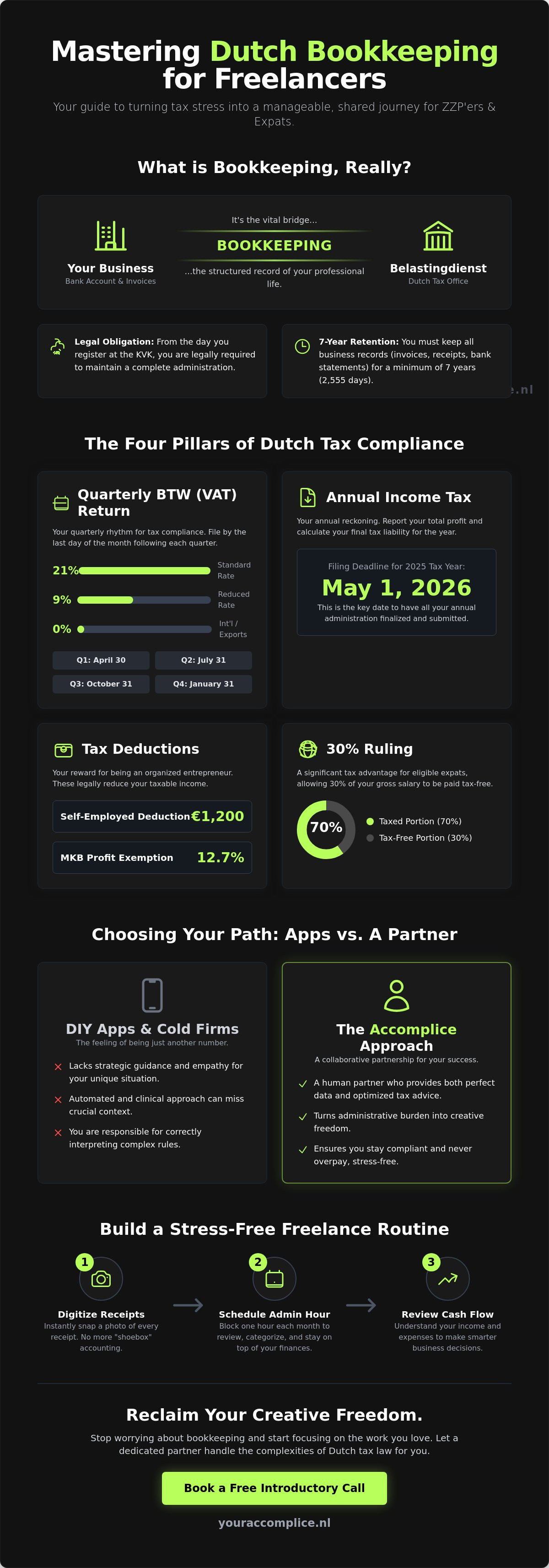
Bookkeeping is often dismissed as a dry pile of receipts and spreadsheets. In reality, it is the structured record of your professional life in the Netherlands. It tells the story of your growth, your investments, and your sustainability as a founder. Think of it as the vital bridge between your bank account and the Belastingdienst, which is the Dutch Tax and Customs Administration. Without this bridge, you're essentially guessing how much money you have to spend versus how much you owe the state. Dutch bookkeeping for freelancers is a mandatory administrative requirement that acts as a strategic tool for every ZZP, which stands for zelfstandige zonder personeel — a self-employed professional without staff.
When you embrace your administration, compliance stops being a source of fear. Instead, it becomes a sign of a healthy, professional freelance business. Staying on top of your records shows that you're in control. It's the difference between a hobby and a scalable business. Every euro accounted for protects you from unexpected audits or fines and gives you the clarity to make informed decisions about your next project or investment.
The Legal Requirements for ZZP and Sole Traders
Your journey begins the moment you register at the KVK, the Dutch Chamber of Commerce. From that day forward, you're legally obligated to maintain an administration. One of the most critical rules in the Netherlands is the seven-year retention obligation. This means you must keep all digital and physical records, including invoices and bank statements, for at least seven years. It's not just about storage — it's about accessibility. We always recommend opening a separate business bank account immediately. Mixing personal groceries with business software subscriptions makes your Dutch bookkeeping for freelancers a nightmare to untangle later. A clean, dedicated account keeps your records transparent and professional from day one.
The Difference Between Bookkeeping and Tax Advice
It's worth distinguishing between the daily grind and the big picture. Bookkeeping is the routine recording of your invoices and expenses — the "what happened" of your financial past. Tax advice is the strategic optimization of your future. It involves looking at your profit and applying specific exemptions to lower your taxable income. While bookkeeping keeps you compliant, tax advice keeps you profitable. At Accomplice, we provide both. We act as your partner to ensure your data is clean and your income tax declaration is optimized so you never overpay. If you're ready to move past the "shoebox" method of accounting, book a free introductory call and let's talk.
The Three Pillars of Dutch Freelance Tax Compliance
Tax compliance in the Netherlands often feels like a puzzle with shifting pieces. To stay on top of your Dutch bookkeeping for freelancers, you need to understand three pillars: BTW, Income Tax, and Deductions. Each one supports your business health in a different way. BTW is your quarterly rhythm. Income tax is your annual reckoning. Deductions are your reward for being organized. Mastering all three ensures you're not just surviving the Dutch system, but actually thriving within it.
Mastering the Quarterly BTW Return
BTW stands for Belasting over de Toegevoegde Waarde — the Dutch version of VAT. Most freelancers deal with the standard 21% rate for services. A reduced 9% rate applies to specific goods like books or certain creative services, while a 0% rate is used for international exports. Deadlines are strict. You must file by the last day of the month following each quarter: April 30, July 31, October 31, and January 31. A common mistake is forgetting to claim back BTW on international business purchases. If you've bought software from a US company, you may need to reverse-charge that VAT to keep your records clean.
Annual Income Tax for the Solo Entrepreneur
Your business profit translates directly to your personal taxable income. In the Netherlands, this falls under Box 1. For 2026, there are two tax brackets: 35.82% on income up to €38,441, and 49.50% on anything above that. If you've recently moved to the Netherlands, you'll likely file an M-form. For established residents, the P-form is standard. To reduce your bill, you can apply specific deductions. The self-employed deduction (zelfstandigenaftrek) is €1,200 for 2026. New entrepreneurs can also claim the startersaftrek of €2,123 up to three times in their first five years. On top of that, the MKB-winstvrijstelling (SME profit exemption) lets you deduct 12.7% of your remaining profit after other deductions. We can help you navigate all of this with our income tax declaration service so no deduction is left behind.
Deductions: What You Can Legally Claim
Home office costs are notoriously strict for an eenmanszaak. Unless your workspace has a separate entrance and its own bathroom, the Belastingdienst rarely allows you to deduct rent or utilities. Travel and transport are more flexible — you can deduct the full cost of business trips by public transport or claim a fixed rate per kilometer for a private car. Professional development is another win: courses, books, and coaching directly related to your work are generally 100% deductible. We've seen many clients save thousands simply by being diligent with these categories throughout the year.
Choosing Your Path: DIY Apps vs. The Accomplice Approach
You've likely seen ads for sleek bookkeeping apps that promise to "automate your life." While these tools are fine for basic data entry, they lack the strategic eye of a human partner. Traditional accounting firms, on the other hand, often feel cold and clinical — treating you like a file number rather than a founder. At Accomplice, we believe Dutch bookkeeping for freelancers should be tech-enabled but human-led. We combine modern tools with a collaborative approach so your focus stays on your business while we handle the compliance.
When is a Bookkeeping App Not Enough?
Apps are great at scanning receipts but often struggle with nuance. An app won't catch if you've incorrectly categorized a private dinner as a business deduction. It won't proactively flag if you're at risk of missing the urencriterium, or remind you of a quarterly BTW deadline before it's too late. Blindly trusting an algorithm can lead to expensive corrections during your annual IB aangifte (income tax return). Having a human partner means someone is actually looking out for your interests — catching mistakes before they reach the tax office and making sure you claim every legal deduction.
The Eenmanszaak Package: Built for Freelance Freedom
We designed our service tiers to eliminate the "invoice shock" that many ZZP'ers face at year-end. Traditional firms bill by the hour, which actually discourages communication — you hesitate to call because every minute costs money. Our philosophy is different. The Eenmanszaak Package is a fixed-price monthly service so you know exactly what your investment is. You get proactive reminders for BTW deadlines, year-round support, and someone who actually knows your situation. No surprises, no hourly billing, no cold emails asking you to send documents you already sent.
Transparency is the core of our partnership. You can view our fixed monthly rates online. If you're tired of feeling like a number to a large firm or a beta tester for an app, let's chat.
Building Your Professional Freelance Routine
Creating a sustainable routine is the secret to moving from a stressed startup to an established professional. For many, Dutch bookkeeping for freelancers feels like a mountain, but it's really just a series of small, manageable habits. When you have a structured workflow, you stop reacting to deadlines and start leading your business with confidence.
Your first step: digitize every receipt immediately. The "shoebox" method is a recipe for panic when the April 30 BTW deadline arrives. Use a simple scanning app to capture expenses the moment they happen. Second, schedule a monthly "Admin Hour" — your time to review cash flow, check which invoices are outstanding, and make sure your bank balance matches your records. Third, categorize your expenses correctly from the start. This ensures you maximize your legal deductions without triggering red flags during an audit.
Preparing for the Annual Income Tax Return
As the year winds down, gather annual statements from your banks and insurance providers. This is also the time to verify your urencriterium — the 1,225-hour rule required to qualify for the self-employed deduction. If you don't track these hours, you risk losing the €1,200 deduction for 2026. With the Eenmanszaak Package, this entire process becomes a non-event. Because we work with you year-round, your income tax declaration is essentially ready before the year even ends. This proactive approach turns a stressful annual reckoning into a simple confirmation of your numbers. If you want to see how we can take this off your plate, schedule a 20-minute chat with us today.
Partner with Accomplice
Accomplice isn't just another service provider — we're your partner in the Dutch business ecosystem. We see the person behind the profit. Whether you're a tattoo artist or a cybersecurity consultant, your business deserves a trusted ally who speaks your language and knows the Dutch system inside out. Dutch bookkeeping for freelancers should feel like a shared journey, not a compliance obligation you dread.
We understand the international workforce. We know the specific hurdles you face, whether you're a ZZP'er running an eenmanszaak or a director of a BV. Our Eenmanszaak Package is designed specifically for freelancers who want to hand off the administrative burden without losing visibility over their finances. You focus on your craft; we keep the books clean, the filings on time, and the Belastingdienst off your back.
Why Founders and Expats Choose Accomplice
We speak your language — literally and figuratively. You won't find clinical jargon or complex legalistic phrasing here. Our fixed pricing respects your budget and your business stage. You'll never face invoice shock because we believe transparency is non-negotiable. We're a modern, tech-savvy team that understands the freelance lifestyle because we work with founders every day. Clarity over complexity. Partnership over paperwork.
If you're ready to stop feeling like a number and start working with someone who actually gets it, book a free 20-minute introductory call. Let's see if we're the right fit.
Reclaim Your Creative Freedom Today
Mastering Dutch bookkeeping for freelancers is about more than hitting the April 30 and May 1, 2026, tax deadlines. It's about understanding the €1,200 self-employed deduction, the startersaftrek, and the 12.7% MKB-winstvrijstelling — and making sure every legal benefit lands in your pocket, not the Belastingdienst's.
By choosing a partner-led approach over a purely automated app, you get someone who actually checks your work, knows your situation, and picks up the phone when something changes. We specialize in expat and founder compliance to ensure you never overpay or miss a critical update. Explore the Eenmanszaak Package and book your free introductory call. Your business deserves a partner that cares as much as you do.
Frequently Asked Questions
Is bookkeeping mandatory for freelancers in the Netherlands?
Yes, maintaining an administration is a legal requirement from the moment you register with the KVK. The Belastingdienst requires you to store all records for at least seven years. Proper Dutch bookkeeping for freelancers ensures you have proof of all business transactions if you're ever selected for an audit.
How much does a bookkeeper for a freelancer cost in 2026?
Basic bookkeeping services typically range from €80 to €200 per month. A full-service annual package including year-end accounts and income tax filing usually runs €1,000 to €2,500. We offer fixed monthly rates so you always know what you're paying and why.
Can I do my own Dutch bookkeeping using an app?
You can use software for basic data entry, but an app can't provide strategic guidance or catch nuanced errors. Most founders find that a combination of modern tooling and a dedicated human partner gives the best balance of efficiency and accuracy.
What is the urencriterium and why does it matter?
The urencriterium requires you to work at least 1,225 hours on your business within a calendar year. Meeting this threshold qualifies you for the self-employed deduction of €1,200 in 2026. This includes all business activities — client work, admin, marketing — and must be documented clearly.
Do I need a separate business bank account as a ZZP'er?
While it's not legally required for an eenmanszaak, it's strongly recommended. Mixing personal and business expenses makes your administration harder to manage and increases the risk of errors in your BTW filings. A dedicated account keeps everything clean and professional.
How often do I need to file VAT (BTW) returns in the Netherlands?
Most freelancers file quarterly, with deadlines on the last day of the month following the quarter's end: April 30, July 31, October 31, and January 31. Missing these dates can result in fines from the Belastingdienst.
What business expenses are tax-deductible for Dutch freelancers?
You can deduct most costs directly related to your business: professional equipment, marketing, coaching, and business travel. Home office costs are only deductible if the space has a separate entrance — a rule the Belastingdienst applies strictly.
How does Accomplice support expats with Dutch tax filings?
We help expats understand their obligations as a ZZP'er or eenmanszaak in the Netherlands, including which forms to file (M-form for new residents, P-form for established ones), how to apply available deductions, and how to stay fully compliant year-round. Book a call and we'll walk you through your specific situation.
Disclaimer
The information in this article is for general guidance only and reflects Dutch tax and accounting rules as understood at the time of writing. It is not personalised advice. Tax rules change, and individual situations vary — so if you're making a financial or tax decision, please speak with a qualified adviser first. If you'd like to talk through your situation with me, you're welcome to book a free introductory call at youraccomplice.nl.